Crowley Strengthens Operations, with a More Reliable Supply Chain, Backed by a $550 Million Bet on LNG
Weekly container volumes now top 900, with greater scheduling discipline, more international traffic than generally assumed, and an energy-resilient microgrid now a year away
Puerto Rico’s cargo schedule used to bend to the weather. Ships slipped, arrivals shifted, and businesses adjusted around it. According to José Nazario, general manager of Crowley Puerto Rico, that is no longer the norm.
“The schedule didn’t have much integrity before. Now, simple weather delays are no longer there,” Nazario revealed in an exclusive interview with Caribbean Business.
That claim is the most concrete result from Crowley’s bigger push to modernize its Puerto Rico operations, a program the company says has drawn more than $550 million in investment across LNG-powered containerships and port infrastructure at the Isla Grande terminal in San Juan.
The centerpiece of that shift is a pair of LNG-fueled vessels, the Coquí and the Taíno, which now run a fixed weekly rotation: the Coquí arriving every Friday, the Taíno every Monday. Together they bring in roughly 850 to 950 containers a week.
For an island where close to 80% of consumer goods arrive by sea, that kind of scheduling discipline becomes the difference between a grocery shelf restocking on time and a disruption that ripples through retailers, construction sites and household budgets alike.
A Track Record Built on New Capacity
Nazario’s reliability claim lines up with what the vessels were designed to do. LNG propulsion gives Crowley’s containerships steadier performance than the conventional fuel-oil engines they replaced. The fixed Friday-Monday rotation has let the company build a predictable cadence around them, replacing what had been a more variable schedule prone to weather-driven slippage.
The volume behind that schedule, 850 to 950 containers per week between the two vessels, represents a meaningful share of the cargo moving through Crowley’s San Juan operation, one of the busiest terminals in Puerto Rico’s supply chain.
That reliability matters because of how dependent Puerto Rico is on what arrives by ship. An island that imports most of what it consumes has little room to absorb port disruptions without consequences reaching retailers, food supply and construction timelines. The efficiency of terminals such as Crowley’s Isla Grande operation functions, in that sense, as a piece of infrastructure the broader economy leans on more than most residents realize.
A Bigger Bet: the LNG-Ready Microgrid
The Coquí and Taíno are the visible part of Crowley’s investment. Less visible, and still months from completion, is a microgrid designed to keep the terminal itself running independent of Puerto Rico’s public grid.
The LNG-powered microgrid will supply power to the terminal’s equipment, refrigerated containers, and administrative and maintenance operations, giving Crowley a source of electricity the company describes as more reliable, lower-cost and cleaner than what the island’s grid currently provides. Critically, it is also designed to keep cargo operations running through a natural disaster, such as a hurricane, when the public grid is most likely to fail.
That project has slipped. Nazario said it was originally announced for completion in early 2026, but is now targeted for the third quarter of 2027, a delay of well over a year.
“We already have the approval for the design,” he said, framing the setback as a matter of sequencing rather than a change in scope.
In a hurricane season that keeps growing more unpredictable, keeping the terminal operational when the rest of the island’s power grid goes down is, in Crowley’s telling, the point of the entire microgrid investment. It also puts a fixed date, third quarter 2027, on when that resilience actually arrives, vs. the early-2026 timeline the company had previously cited.
Balancing LNG With Other Cargo
Puerto Rico’s reliance on natural gas for electricity has been growing for years, and PREPA’s long-term resource planning calls for gas to keep expanding as a share of the island’s generation mix as older oil-fired units retire.
In addition to Crowley, EcoEléctrica—the Peñuelas power plant owned by Spain’s Naturgy, France’s Engie and Japan’s Mitsui—has run its own LNG import and regasification terminal for roughly 25 years. New Fortress Energy’s local subsidiary, NFEnergía, separately operates an LNG facility in San Juan Bay that feeds the San Juan power plant.
Crowley owns and operates American Energy, the first U.S.-flagged LNG carrier dedicated to serving Puerto Rico, which delivers U.S.-sourced LNG to EcoEléctrica’s terminal under a multiyear agreement with Naturgy. Separately, Crowley runs its own LNG Loading Terminal in Peñuelas, a smaller-scale operation that supplies roughly 94 million gallons of LNG a year to industrial and commercial customers through truck-mounted containers, not to the power grid directly.
Against that backdrop, as San Juan Bay accommodates growing LNG-related vessel traffic alongside Crowley’s own containership schedule and everything else the port handles, Nazario raised a capacity concern.
“We just have to be careful with the size of the vessels arriving at the bay. Right now there is an issue with the vessels in terms of letting the traffic of the bay flow, so in terms of capacity we do have it, we just have to be mindful that there’s other cargo that has to arrive, which is just as important as the LNG.”
In other words, as Puerto Rico’s demand for gas grows and larger vessels compete for space at the bay, the terminals serving that demand, Crowley’s included, will need to coordinate carefully so that LNG traffic does not come at the expense of the general cargo, food and fuel the island also depends.
Nazario argues that Puerto Rico’s position in global trade is more complex than the domestic-island narrative suggests
Cargo From Around the World, Not Just the Mainland
Speaking of other cargo, Nazario pushed back on the general assumption that Puerto Rico’s supply chain runs almost entirely through the U.S. mainland.
“It is a myth that everything that comes in is domestic. Around 35% is international, while 65% is domestic.”
A supply chain drawing more than a third of its volume from international origins carries different exposure to global shipping schedules, foreign-port disruptions, and trade policy, than one running more overwhelmingly on domestic routes. Nazario, in effect, argues that Puerto Rico’s position in global trade is more complex than the domestic-island narrative suggests, even as the Jones Act drives much of that cargo.
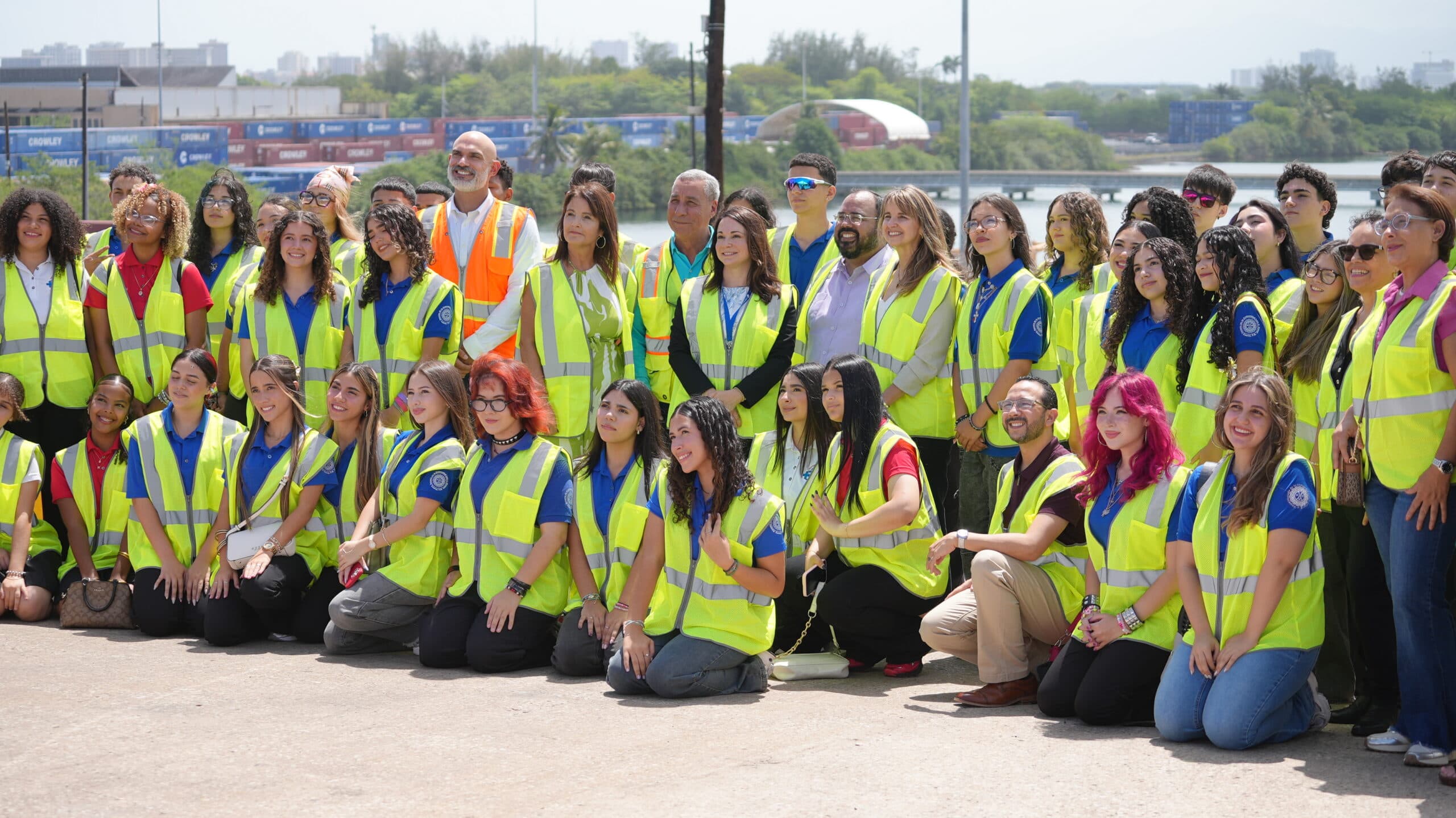
Nazario spoke with Caribbean Business on Friday during an event at Crowley’s Isla Grande terminal, where more than 350 public school students were taking part in a workforce-development initiative with Junior Achievement Americas and Puerto Rico’s Department of Education, introducing the next generation to careers in the maritime and logistics industries Crowley’s investments depend on.
Crowley and Junior Achievement Americas respond by bringing 350 students to Isla Grande terminal Friday, part of a push to build the island’s maritime and logistics workforce pipeline